
🛰️ AuditSec Intel™ 1092
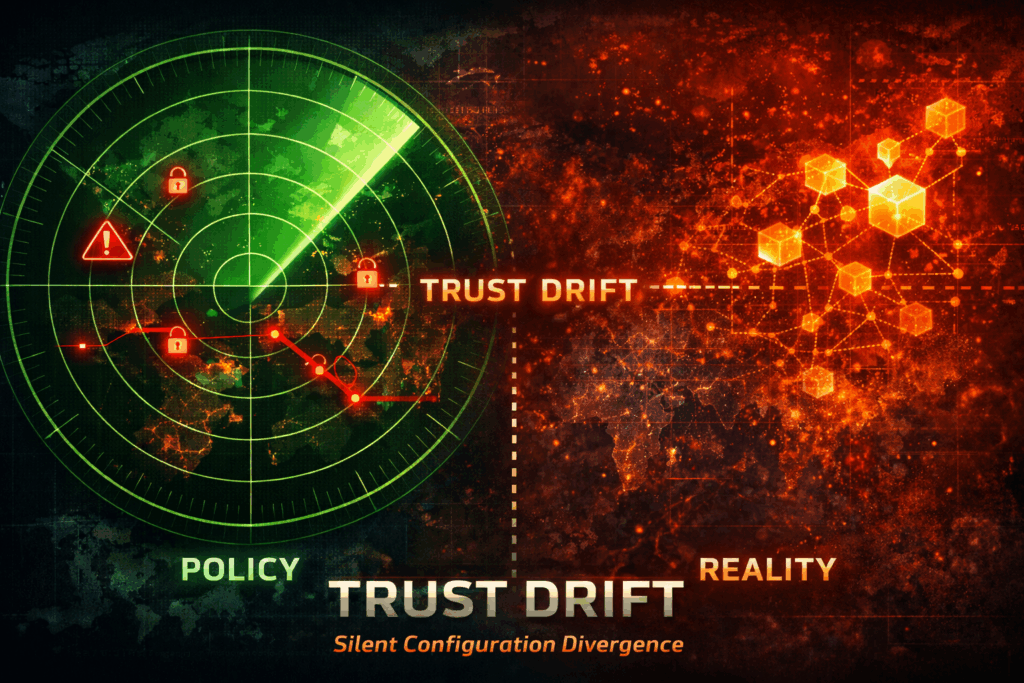
“Trust Drift: The Silent Risk Between Policy and Reality”
⚠️ The Invisible Exposure
Most organizations believe they are secure because:
- Policies exist
- Controls are documented
- Certifications are active
- Dashboards show green
But security does not fail at the moment of design.
It fails in the space between:
What is approved… and what is actually running.
That space is called Trust Drift.
🧠 What Is Trust Drift?
Trust Drift occurs when:
- Access accumulates quietly
- Configurations change incrementally
- Automation modifies behavior
- Vendors expand integration scope
- Exceptions never expire
No breach.
No alert.
No incident.
Just slow divergence.
And over time — divergence becomes exposure.
🔎 Where Drift Hides
| Control Area | Intended State | Drift Signal |
|---|---|---|
| Identity Governance | Least privilege | Privilege creep |
| Change Management | Approved updates | Silent config changes |
| Vendor Access | Scoped integration | API expansion |
| Automation | Guarded execution | Autonomous privilege |
| Logging | Complete audit trail | Selective logging |
Drift does not trigger alarms.
It erodes guardrails.
🧨 Real Scenario: “Approved Once, Forgotten Forever”
An enterprise granted temporary admin rights during a migration.
The migration ended.
The privilege did not.
Months later, the account became the entry point for lateral movement.
The policy was correct.
The environment was not.
Trust drifted.
📊 CISORadar Drift Indicators (TDI Alignment)
Boards should monitor:
- % of temporary access exceeding SLA
- Number of config changes outside CAB
- Vendor scope changes not re-certified
- Automation accounts not reviewed in 90 days
- Exceptions older than policy duration
If drift is not measured — it compounds.
🧠 Control Test of the Week
Drift Exposure Scan
1️⃣ Extract current IAM privilege snapshot
2️⃣ Compare against approved baseline
3️⃣ Identify temporary roles beyond SLA
4️⃣ Cross-check vendor integration scope
5️⃣ Validate automation privilege boundaries
6️⃣ Calculate Trust Drift Index (TDI)
🧭 Leadership Takeaway
Security maturity is not about preventing change.
It is about preventing uncontrolled evolution.
Boards must stop asking:
“Are we compliant?”
And start asking:
“How far has reality drifted from our approved state?”
Because:
Drift is slow.
Drift is quiet.
Drift is compounding risk.
🔖 SEO Tags
#AuditSecIntel #TrustDrift #CyberGovernance #ISO27001 #NIST #CISORadar #BoardCyberRisk #IdentitySecurity #ConfigurationManagement #DigitalTrust
Leave a Reply